1. Introduction to pyscript
PyScript is a platform for Python in the browser.
It combines html, css, and python in separate files.
PyScript is designed to allow the running of Python in web browsers.
PyScript apps can be hosted as a static web site.
1.1. Key references:
User guide: https://docs.pyscript.net/2025.11.2/user-guide/
Developer blog on latest update changes: https://jeff.glass/tags/pyscript/
1.2. Sign up
Sign up is free.
Go to https://pyscript.com/ and sign up.
1.3. New project
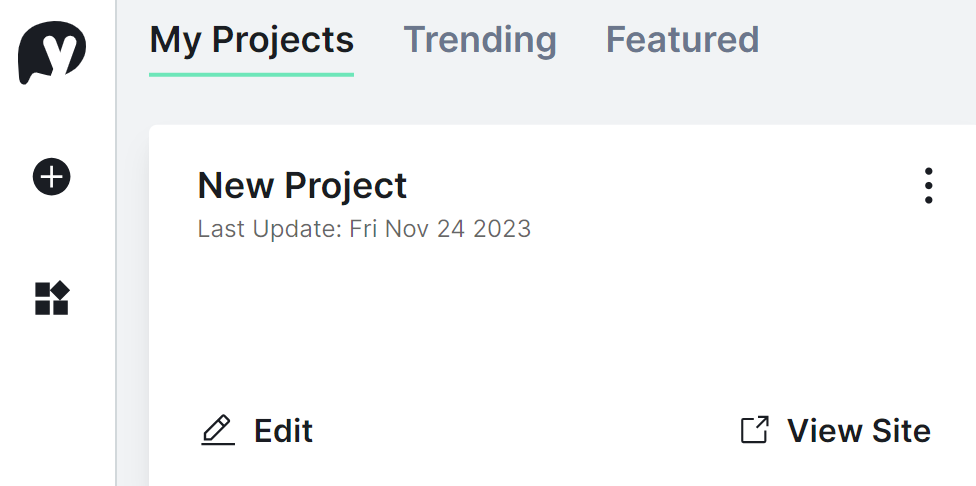
To start a new project, on the dashboard, click the new project (plus) button.
1.4. Project files
Making a new project in pyscript starts with 3 files.
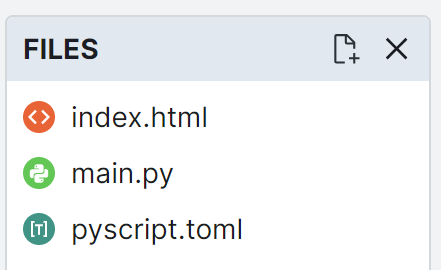
The index.html file is served to your browser. It has the interface elements and links to python code.
The main.py is for python code that defines how your application works.
The pyscript.toml file is used to configure the project.
e.g specifying python modules via
packages = ["numpy", "pandas"]. It can be empty.For using comments and more complicated configurations use a toml file.
Alternatively, a pyscript.json file can be used instead of the pyscript.toml file. An empty json file needs curly brackets as {}.
A main.css file is often added to customize the html element appearance.
1.5. toml file
See: https://docs.pyscript.net/2025.11.2/user-guide/configuration/
e.g. toml file
name = "Temp converter"
description = "Fahrenheit <-> Celsius converter with integer values"
packages = []
In PyScript's TOML configuration files, the name and description fields are primarily used for documentation and organizational purposes.
They help you and others understand the purpose and functionality of the application at a glance.
While these fields are not used directly by PyScript to influence the behavior of your application, they are valuable for maintaining clarity and organization within your project.
1.6. favicon.ico file
For creating favicon.ico from a png file see: https://www.favicon.cc/?
The favicon.ico is placed in the files section in the pyscript editor so it shows in a browser tab.
The head reference to the favicon is <link rel="icon" href="favicon.ico" type="image/x-icon">.
Since this is optional it can be omitted.
1.7. index.html
The index.html file starts as a basic template.
The latest versions of the <link> and <script> tags have been inserted as shown below (as of Dec 2024).
<!DOCTYPE html>
<html lang="en">
<head>
    <title>App title</title>
    <!-- Recommended meta tags -->
    <meta charset="UTF-8">
    <meta name="viewport" content="width=device-width,initial-scale=1.0">

    <!-- favicon to appear in browser tab -->
    <link rel="icon" href="favicon.ico" type="image/x-icon">

    <!-- PyScript CSS -->
    <link rel="stylesheet" href="https://pyscript.net/releases/2025.11.2/core.css">

    <!-- This script tag bootstraps PyScript -->
    <script type="module" src="https://pyscript.net/releases/2025.11.2/core.js"></script>

    <!-- custom CSS only -->
    <link rel="stylesheet" href="main.css">
</head>
<body>
    <script type="py" src="./main.py" config="./pyscript.toml></script>
</body>
</html>
1.8. Terminal
To view the terminal as well use this script tag in the body:
...
<script type="py" src="./main.py" config="./pyscript.toml" terminal></script>
...